
What Colleges Really Want to See From Homeschool Applicants
3/21/20267 min read
If you are homeschooling a high schooler and college is on the horizon you have probably asked yourself this question — will colleges actually take my homeschool student seriously? The answer is an unqualified yes. Colleges across the country not only accept homeschool graduates they actively recruit them. Homeschool graduates have a strong track record of academic success at the college level and admissions officers have become increasingly sophisticated in evaluating homeschool applications.
But here is the thing — the homeschool college application process is different from the traditional one in some important ways. Knowing exactly what colleges want to see from homeschool applicants and making sure you have everything prepared gives your student a genuine competitive advantage.
This guide breaks down exactly what colleges want from homeschool applicants — the documents, the credentials, the experiences, and the intangibles that make a homeschool application stand out.
The Foundation — Official Academic Documentation
Everything starts with documentation. Before a college admissions officer can evaluate your student academically they need official documents that tell the story of your student's academic preparation clearly and professionally. Here is what most colleges require from homeschool applicants as a baseline.
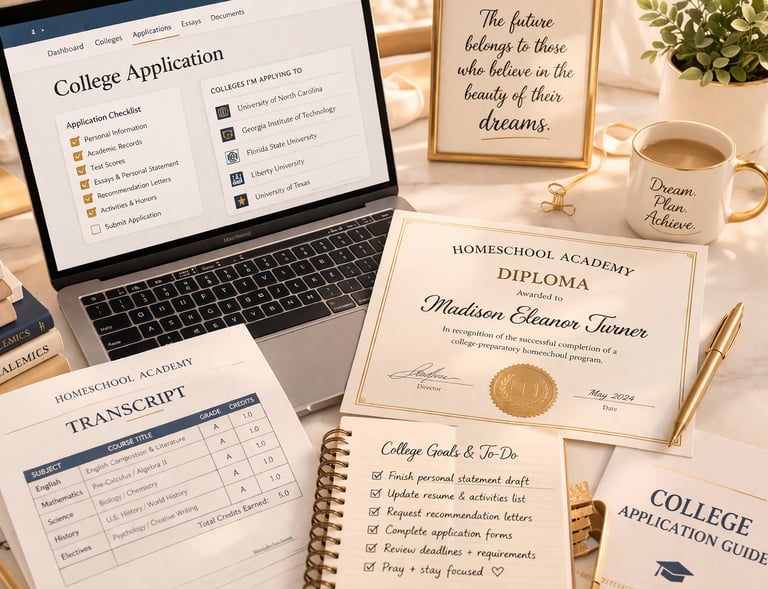
Official Transcript The transcript is always the first thing requested. Your homeschool transcript needs to be complete, accurate, and professionally formatted. It should include every course completed during high school organized by academic year, the grade earned in each course, credit hours, cumulative GPA, graduation date, your homeschool name, your student's full legal name, and your signature as the issuing parent educator.
A professional looking transcript signals to the admissions officer that your homeschool program was serious and well-organized. A handwritten or poorly formatted transcript — even if the content is strong — creates an unnecessary first impression problem.
Course Descriptions Many colleges — especially competitive ones — request course descriptions from homeschool applicants. Course descriptions explain what your student actually studied in each course, what curriculum was used, what major topics were covered, and how mastery was assessed. They give the admissions officer the context they need to evaluate the rigor of your student's coursework fairly.
Prepare course descriptions for every course on your student's transcript. Keep them concise — one to three paragraphs per course — and make sure they are professionally written and formatted.
Homeschool Diploma Your homeschool diploma is the official document certifying your student's completion of their high school education. Most colleges accept the parent-issued homeschool diploma as a legitimate credential when it is accompanied by a complete transcript and supporting documentation. Make sure your diploma looks professional — clean design, your homeschool name, your student's full legal name, graduation date, and your signature.
Cumulative Academic Record Some colleges request a cumulative academic record that goes beyond the transcript to include extracurricular activities, community service, awards, leadership roles, and work experience. Even if a college does not specifically request this document having one prepared and ready to submit demonstrates thoroughness and professionalism.
Standardized Test Scores
Standardized test scores play an important role in many homeschool college applications. While the test-optional movement has grown significantly at many institutions homeschool applicants sometimes find that submitting strong test scores actually strengthens their application — even at schools that are technically test-optional.
Here is why. When a college admissions officer reviews a homeschool transcript they cannot rely on the same external validation they have with traditional school transcripts — class rank, school profile, district accreditation, and so on. Strong SAT or ACT scores provide an independent third-party verification of your student's academic preparation that gives the admissions officer additional confidence in the transcript grades.
Encourage your student to take the SAT or ACT seriously and to prepare thoroughly. Strong scores open doors at competitive colleges and can unlock significant scholarship opportunities at schools across the selectivity spectrum.
If your student is aiming for highly selective colleges also consider AP exams. Taking and passing AP exams — especially in subject areas where your student excels — provides additional external validation of academic rigor and preparation.
Letters of Recommendation
Most colleges require two to three letters of recommendation from sources who can speak to your student's academic ability, character, and potential. For homeschool applicants the recommendation letter strategy requires some thought.
Who to Ask Since your student does not have traditional classroom teachers to ask for recommendations think creatively about who in your student's life can speak authentically to their academic ability and character. Strong candidates include community college professors if your student took dual enrollment courses, co-op instructors or tutors who taught your student specific subjects, coaches or activity leaders who can speak to your student's character and work ethic, employers or volunteer supervisors who can speak to responsibility and maturity, and mentors or pastors who know your student well and can speak to character and potential.
What Makes a Strong Letter A strong recommendation letter is specific, personal, and enthusiastic. It tells a story about your student — a specific moment, achievement, or quality that the writer observed directly. Generic letters that could have been written about anyone are less valuable than specific letters that paint a vivid picture of who your student is.
Can a Parent Write a Recommendation At most colleges a parent recommendation is not appropriate as one of the required letters because it is seen as lacking objectivity. Some colleges specifically invite a statement from the homeschooling parent as a separate document — often called a homeschool profile or school profile — but this is different from a student recommendation letter. Check the specific requirements of each school your student applies to.
The Personal Statement
The personal statement is where your homeschool student has a genuine advantage. Homeschool graduates typically have a richer, more varied, and more self-directed educational experience than their traditionally schooled peers. They often have more developed opinions about learning, more experience with self-motivation and independent study, and more interesting stories to tell about their educational journey.
The personal statement is your student's opportunity to tell their story in their own voice. Here is what makes a homeschool personal statement stand out.
Be specific and personal. Avoid generic statements about homeschooling in general. Instead tell a specific story about a moment, a project, a book, an experience, or a challenge that shaped your student as a learner and a person.
Connect the homeschool experience to future goals. Show the admissions officer how your student's unique educational journey has prepared them for college and for the specific field or path they want to pursue.
Demonstrate intellectual curiosity and self-direction. Colleges love students who are genuinely curious, who pursue learning beyond what is required, and who take initiative. If your student has done any of these things — independent research, a passion project, extensive reading in a specific field, entrepreneurship, creative work — the personal statement is the place to highlight it.
Do not apologize for homeschooling. Some homeschool applicants make the mistake of being defensive about their educational background in the personal statement. Do not. Your student received a rigorous, intentional, personalized education. Own it with confidence.
Extracurricular Activities and Community Involvement
Colleges want to see students who are engaged in their communities and who pursue interests and passions outside of academics. For homeschool students who may not have had access to traditional school-based activities the key is demonstrating engagement and involvement through other channels.
Document everything your student has been involved in — sports leagues, music programs, art classes, co-op activities, community theater, volunteer work, religious youth groups, community service, leadership roles, jobs, entrepreneurial ventures, and independent projects. Any structured activity that demonstrates engagement, commitment, and growth belongs on the activities list.
Quality matters more than quantity. A student who has been deeply involved in one or two activities for multiple years — demonstrating growth, leadership, and commitment — makes a stronger impression than a student with a long list of activities with minimal involvement in each.
Dual Enrollment — A Powerful Differentiator
If your student has the opportunity to take dual enrollment courses at a community college during high school take it. Dual enrollment serves multiple purposes for homeschool college applicants.
It provides external academic validation — an official transcript from an accredited institution that demonstrates your student can perform successfully in a college academic environment. It gives your student experience with college-level coursework and the college classroom environment before freshman year. It often earns college credit that can reduce the time and cost of completing a degree. And it gives your student access to recommendation letters from college professors who can speak to their academic ability with institutional credibility.
Even one or two dual enrollment courses taken during junior or senior year can significantly strengthen a homeschool college application.
The Homeschool Profile or School Profile
Some colleges invite or require a homeschool profile — a brief document written by the homeschooling parent that describes the educational philosophy, curriculum approach, grading scale, and general structure of the homeschool program. This is separate from the student's application materials and it gives the admissions officer additional context for understanding the transcript.
A well-written homeschool profile is concise, professional, and informative. It should include your educational philosophy in two to three sentences, a description of your general curriculum approach and the primary materials used, an explanation of your grading scale and how grades were determined, a brief description of any outside coursework, co-op participation, or dual enrollment, and contact information for the homeschooling parent.
Not every college requests a homeschool profile but having one prepared and ready to submit demonstrates professionalism and thoroughness.
Done For You — Professional Documentation That Opens Doors
The foundation of a strong homeschool college application is professional documentation. A polished transcript, a well-designed diploma, thorough course descriptions, and a complete cumulative academic record give your student the credibility they deserve going into the application process.
Homeschool Glow Design House creates all of these documents for you — professionally designed, officially formatted, and delivered print-ready to your inbox. Our Full Records Package includes everything your college-bound homeschool graduate needs to walk into the application process with confidence.
Ready to get your student's documentation college-ready? Visit our Order Now page and choose the package that fits your family.
Colleges want homeschool graduates. They want students who are self-directed, intellectually curious, academically prepared, and personally mature. Those are exactly the qualities that a well-executed homeschool education develops. Your student has what colleges are looking for — make sure the application package shows it clearly.
Professional documentation, strong test scores, authentic recommendation letters, a compelling personal statement, and documented community involvement — put these together and your homeschool graduate walks into the college application process as a competitive, confident, well-prepared applicant.
That is exactly what they deserve to be.
Contact Us
Homeschool Glow provides general educational guidance and organizational tools. Families are responsible for confirming requirements with their state.
© 2026. All rights reserved.
Important Note
Homeschool Glow Design House —Your Homeschool. Officially Documented. Beautifully Designed.