
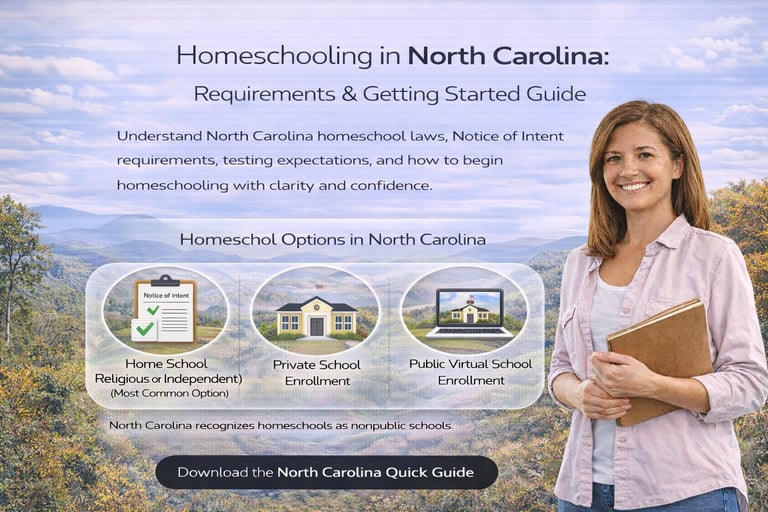
Homeschooling in North Carolina: Requirements & Getting Started Guide
Understand North Carolina homeschool laws, Notice of Intent requirements, testing expectations, and how to begin homeschooling with clarity and confidence.
Quick Answer Box
Is homeschooling legal in North Carolina?
Yes. Homeschooling is legal in North Carolina.
Do you have to notify the state?
Yes. Families must file a Notice of Intent with the North Carolina Division of Non-Public Education (DNPE).
Is testing required?
Yes. North Carolina requires annual standardized testing.
Are attendance records required?
Yes. Families must maintain attendance and immunization records.
HOMESCHOOL OPTIONS IN NORTH CAROLINA
North Carolina recognizes homeschools as nonpublic schools.
Home School (Religious or Independent) – Most Common Option
Parents file a Notice of Intent and operate as a private, nonpublic school under state guidelines.
Private School Enrollment
Families may choose traditional private school enrollment instead of independent homeschooling.
Public Virtual School Enrollment
Families may enroll in approved public virtual programs if they prefer district oversight.
What You Must Do
File a Notice of Intent with the DNPE
Provide instruction in required subject areas, including:
Reading
Writing
Mathematics
Science
Social studies
Administer a nationally standardized test annually
Maintain attendance and immunization records
Operate on a regular school schedule
What Records North Carolina Homeschool Families Keep?
North Carolina families must maintain organized documentation.
Required and recommended records include:
Copy of Notice of Intent approval
Attendance log
Immunization records
Standardized test results
Curriculum outline
Work samples and portfolio
High school transcripts (if applicable)
Need help organizing your homeschool records?
Getting Started in North Carolina
Submit your Notice of Intent to the DNPE.
Choose curriculum covering required subject areas.
Set up a simple system for attendance tracking.
Schedule annual standardized testing.
Keep organized records for peace of mind.
Homeschooling does not have to feel overwhelming — clarity and structure make all the difference.
IMPORTANT NOTE
Homeschool Glow provides general educational guidance and organizational tools. Families are responsible for confirming requirements with their state and local authorities.
Contact Us
Homeschool Glow provides general educational guidance and organizational tools. Families are responsible for confirming requirements with their state.
© 2026. All rights reserved.
Important Note
Homeschool Glow Design House —Your Homeschool. Officially Documented. Beautifully Designed.