
How to Write Course Descriptions for Your Homeschool Transcript
3/21/20267 min read

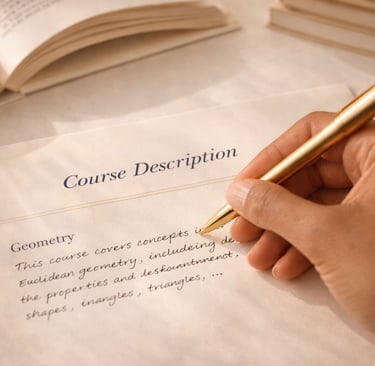
Course descriptions are one of the most overlooked pieces of homeschool graduation documentation — and one of the most valuable. Most homeschool parents know they need a transcript and a diploma. Far fewer realize that course descriptions can be the difference between a college application that gets a second look and one that raises questions an admissions officer cannot easily answer.
The good news is that writing course descriptions is not as complicated as it sounds. Once you understand what they are, what goes in them, and how to write them clearly you will be able to put together a complete set of course descriptions that strengthens your student's application and gives every reviewer exactly the context they need.
This guide is going to walk you through everything — what a course description is, why it matters, what to include, and how to write one even if your child studied from multiple sources or used an unconventional approach.
What Is a Course Description
A course description is a brief written explanation of the content, curriculum, and objectives of a specific course your homeschool student completed. It answers the question that a course name alone cannot answer — what did this student actually study in this course and how was it taught?
When a college admissions officer sees "American Literature" on a homeschool transcript they cannot automatically assume what that course covered the way they might with a traditionally schooled student. Did the student read three books or thirty? Did they write analytical essays or just book reports? Was the course taught from a classical perspective, a faith-based perspective, or a secular academic perspective? A course description answers all of these questions clearly and concisely.
Course descriptions are typically one to three paragraphs long per course. They are not exhaustive academic syllabi — they are clear, professional summaries that give the reader enough information to understand the scope and rigor of the course.
Why Course Descriptions Matter
Course descriptions matter for several reasons that directly affect your student's post-secondary opportunities.
College Admissions — Many colleges request course descriptions from homeschool applicants as part of their standard admissions process. Competitive colleges and universities in particular want to understand the rigor and content of the coursework behind the transcript grades. A well-written set of course descriptions demonstrates that your homeschool program was serious, thorough, and academically rigorous.
Scholarship Applications — Scholarship committees often have the same questions as admissions officers. Course descriptions give them the context to evaluate your student's academic preparation fairly and completely.
Dual Enrollment — If your student wants to take community college courses before graduating many institutions require documentation of completed high school coursework. Course descriptions help demonstrate prerequisite knowledge and preparation.
Your Own Peace of Mind — Writing course descriptions forces you to articulate what your student learned and how you taught it. That process often reveals just how much ground your student actually covered — which is encouraging and validating for homeschool parents who sometimes wonder if they are doing enough.
What to Include in a Course Description
Every course description should include the same core elements. Here is exactly what to cover for each course.
Course Name
Use the full official course name as it appears on the transcript. Be specific and use standard academic language. "British Literature" rather than "Reading." "Biology with Lab" rather than "Science."
Grade Level and Credit Hours
Note the grade level in which the course was completed and the number of credit hours assigned. This helps the reviewer understand where the course fits in your student's academic sequence.
Course Overview
Write two to three sentences summarizing what the course covered at a high level. What was the primary focus of the course? What major topics or themes did it address? This is your opening paragraph and it sets the context for everything that follows.
Curriculum and Materials Used
List the primary textbook or curriculum program used. Include the title, author or publisher, and edition if relevant. If you used multiple resources list the primary ones. This is one of the most important elements of the course description because it gives the reviewer a concrete reference point for evaluating the rigor of the course.
Topics and Skills Covered
Provide a brief list or description of the major topics covered and skills developed in the course. For a literature course this might include the titles of major works read, the writing skills developed, and the literary analysis skills practiced. For a science course this might include the major units covered and whether laboratory work was included.
Assessment Methods
Briefly describe how student mastery was assessed. Tests and quizzes, essays and papers, projects and presentations, lab reports, oral narrations, portfolios — whatever assessment methods you used belong here. This demonstrates that grades were based on real evaluation rather than arbitrary assignment.
Special Notes
If anything about the course warrants additional explanation include it here. For example if your student completed an honors-level version of the course, if the course was dual enrolled through a community college, or if the course involved significant independent research or a major culminating project note it here.
How to Write a Course Description — Step by Step
Here is a simple process for writing course descriptions that produces professional results without overwhelming you.
Step 1 — Gather Your Materials
Pull out the curriculum or textbook you used, your lesson plans or course outline if you kept them, your gradebook, and any major assignments or projects your student completed. Having these materials in front of you makes the writing process much easier.
Step 2 — Start With the Overview
Write two to three sentences summarizing what the course was about at a high level. Do not try to cover everything — just capture the essence of the course in a few clear sentences. This is your opening paragraph.
Step 3 — List the Curriculum
Write one sentence identifying the primary curriculum or textbook used. Include the title and publisher. If you used multiple resources write a brief sentence for each major one.
Step 4 — Describe the Content
Write a paragraph or bulleted list describing the major topics covered in the course. Think about the units you taught, the skills you developed, and the major works or projects completed. You do not need to list every single topic — focus on the most significant ones.
Step 5 — Describe Assessment
Write one to two sentences explaining how you assessed your student's mastery. Keep it simple and honest. Tests, papers, projects, presentations, narrations — whatever you used.
Step 6 — Review and Polish
Read back through what you wrote and make sure it is clear, professional, and accurate. Check that the course name matches the transcript exactly. Make sure the credit hours are noted correctly. Read it as if you are a college admissions officer seeing it for the first time — does it give you a clear picture of what the student learned?
Course Description Examples
Here are two examples of well-written homeschool course descriptions to give you a clear model to follow.
Example 1 — American Literature
American Literature — Grade 11 — 1.0 Credit
This course provided a comprehensive survey of American literary works from the colonial period through the twentieth century. Students examined the major movements, themes, and voices that have shaped American literary tradition including Puritanism, Romanticism, Realism, and Modernism.
Primary curriculum: Memoria Press American Literature. Supplemental works included selections from Nathaniel Hawthorne, Mark Twain, F. Scott Fitzgerald, John Steinbeck, and Langston Hughes among others.
Major skills developed included close reading and literary analysis, thematic essay writing, research paper composition, and oral presentation. Assessment included weekly reading comprehension checks, literary analysis essays, a research paper, and a final oral presentation.
Example 2 — Biology with Lab
Biology with Lab — Grade 9 — 1.0 Credit
This course provided a thorough introduction to biological science including the study of cell biology, genetics, ecology, evolution, human anatomy, and the diversity of living organisms. Laboratory work was integrated throughout the course to reinforce conceptual learning through hands-on experimentation.
Primary curriculum: Apologia Exploring Creation with Biology. Laboratory experiments were conducted using the Apologia lab kit with written lab reports completed for each experiment.
Major topics covered included cell structure and function, DNA and genetics, classification of living things, ecosystems and environmental science, and human body systems. Assessment included chapter tests, written lab reports, and a comprehensive final examination.
Writing Course Descriptions for Unconventional Courses
Not every homeschool course fits neatly into a standard academic category and that is completely fine. Here is how to handle some common situations.
Unit Studies — If you used a unit study approach that integrated multiple subjects describe the primary subject focus of the course and note the integrated nature of the instruction. Assign credit hours based on the time invested and the primary academic skill developed.
Living Books and Literature-Based Approaches — List the primary books read, the skills developed, and the assessment methods used. A literature-rich approach can produce excellent course descriptions when the books and skills are articulated clearly.
Co-op or Outside Classes — For courses taken through a co-op or outside provider include the name of the provider, the instructor if known, and a brief description of the course content. If an official course description was provided by the instructor include it or adapt it.
Life Skills and Practical Courses — Courses like personal finance, home economics, or practical life skills are legitimate high school courses when documented well. Describe the content covered, the skills developed, and how mastery was assessed just as you would for any academic course.
Done For You — Let Us Write Them For You
Writing course descriptions for four years of high school courses is a significant project. It requires pulling together curriculum records, articulating what was taught clearly and professionally, and formatting everything consistently. That is exactly what our Full Records Package at Homeschool Glow Design House includes.
We create professional course descriptions for every course on your student's transcript — clearly written, professionally formatted, and ready to submit with college applications and scholarship materials. You provide the curriculum information and we handle the rest.
Ready to get your complete graduation documentation done right?
Visit our Order Now page and choose the package that fits your family.
Course descriptions are your opportunity to tell the full story of your student's education — not just what grade they earned but what they actually learned, how they were taught, and what they are capable of. Take the time to write them well and they will serve your student powerfully in every application process they enter.
Whether you write them yourself using this guide or let Homeschool Glow Design House create them for you make sure every course on your student's transcript has a description behind it. Your student's education deserves to be fully seen and understood.
Contact Us
Homeschool Glow provides general educational guidance and organizational tools. Families are responsible for confirming requirements with their state.
© 2026. All rights reserved.
Important Note
Homeschool Glow Design House —Your Homeschool. Officially Documented. Beautifully Designed.