
How to Set Up Your Homeschool Records From Day One
3/21/20266 min read
Here is the truth about homeschool records that nobody tells you on day one — the families who struggle most at graduation time are almost never the ones who did not teach well enough. They are the ones who did not keep records well enough. Four years of excellent education can be incredibly difficult to document after the fact. But four years of consistent simple recordkeeping makes graduation documentation almost effortless.
This guide is going to show you exactly how to set up your homeschool records from the very first day of instruction so that by the time your student is ready to graduate everything you need is already organized and ready to go. Whether your child is in kindergarten or just starting high school the best time to set up your recordkeeping system is right now.
Why Recordkeeping Matters More Than You Think
Homeschool records serve several important purposes beyond just satisfying legal requirements. They are the foundation of your child's academic credentials. They are what you draw from when creating transcripts, course descriptions, and portfolios. They are what colleges, employers, and trade programs ask for when your graduate applies. And they are your protection — documentation that demonstrates you provided a quality education if that is ever questioned.
Good records also help you as the educator. Tracking what your child has covered, how they are progressing, and what needs more attention makes you a more effective teacher. Records are not just administrative paperwork — they are a tool for better homeschooling.
The Five Records Every Homeschool Family Needs
Regardless of your state's specific requirements these are the five records every homeschool family should maintain from day one.
1. Attendance Log
Your attendance log is your proof that your child received instruction on a given day. It does not need to be elaborate — a simple calendar where you mark each instructional day is sufficient for most families and most states.
Some families use a physical wall calendar. Others use a Google Sheet. Others use a dedicated homeschool app. The format does not matter as much as the consistency. Mark every day you school. Include the date and if your state requires it the subjects covered that day.
At the end of each school year count your days and confirm you met your state's minimum requirement — typically 180 days. File your completed attendance log and start fresh the next year.
2. Course and Curriculum Records
Keep a running record of every subject or course your student is studying, the curriculum or materials being used, and the approximate start and end dates. This does not need to be a formal document — a simple spreadsheet or even a notebook works fine.
For high school students this record becomes the foundation of your transcript. Every course listed here will eventually appear on the official transcript so the more detail you capture now the easier transcript preparation will be later.
Include the full name of each course, the publisher and title of the primary curriculum or textbook, any supplemental materials used, and a brief note about the scope of the course — what topics it covered and how instruction was delivered.
3. Grade Records
Your grade records are your gradebook. For every subject your student studies you need a record of assignments completed, assessments given, grades earned, and any major projects or papers produced.
For elementary students grades are less critical since you are not building toward a high school transcript yet. But the habit of tracking work and progress is worth establishing early. For middle and high school students grade records are essential because they feed directly into your official transcript and GPA calculation.
Keep your grade records organized by school year and by subject. At the end of each year calculate final grades for each course and record them alongside the credit hours assigned. This is your raw material for transcript preparation.
4. Work Samples and Portfolio
Work samples are physical or digital examples of your student's actual work — essays, math tests, science projects, art pieces, research papers, lab reports, and any other significant assignments. A portfolio is a curated collection of your student's best and most representative work.
Work samples serve multiple purposes. They are evidence of the quality of instruction your child received. They are required in some states as part of annual assessment. They are valuable for college applications — especially for students applying to art programs, writing programs, or other disciplines where demonstrated skill matters. And they are a meaningful record of your child's growth over time.
Get in the habit of saving work samples consistently throughout the year. A simple manila folder for each subject or a digital folder in Google Drive works well. At the end of the year review what you saved and select the strongest pieces for the portfolio.
5. Extracurricular and Achievement Records
This is the record that most homeschool families forget to keep and then scramble to reconstruct at college application time. From day one keep a running log of everything your student does outside of formal academics — sports teams, music lessons, art classes, volunteer work, community service, co-op classes, leadership roles, jobs, awards, competitions, and any other significant experiences.
For college-bound students this record becomes the foundation of their activities list and their cumulative academic record. For all students it is a meaningful documentation of who they are as a whole person beyond their coursework.
How to Organize Your Records
There is no single right way to organize homeschool records. The best system is the one you will actually use consistently. Here are three approaches that work well for different families.
The Binder System Create one binder per school year. Divide it into sections for attendance, course records, grades, work samples, and extracurricular records. At the end of each year the binder is complete and goes on the shelf. Simple, physical, and easy to grab when you need it.
The Digital System Create a Google Drive folder for each school year. Inside that folder create subfolders for each subject. Store digital copies of everything — attendance logs, curriculum records, grade spreadsheets, scanned work samples, and extracurricular records. This system is searchable, backed up automatically, and accessible from anywhere.
The Hybrid System Keep physical work samples and a physical attendance calendar but maintain grade records and course logs digitally. Many families find this combination works well because it captures the irreplaceable nature of physical work while keeping data organized and accessible.
Recordkeeping for High School — Special Considerations
High school records require a higher level of organization and detail than elementary or middle school records because they feed directly into graduation documentation. Here are the specific things to track carefully during the high school years.
Credit Hours — Track credit hours for every course from the first day of 9th grade. A standard full-year course earns one credit. A semester course earns half a credit. Keep a running total so you always know where your student stands relative to graduation requirements.
Course Names — Use standard academic course names that will be recognizable to college admissions officers. Instead of "Science" write "Biology" or "Chemistry." Instead of "Math" write "Algebra I" or "Geometry."
Grades and GPA — Calculate semester and final grades for each course and maintain a running cumulative GPA. Update it at the end of every school year so you always know your student's current standing.
Dual Enrollment and Outside Courses — If your student takes courses through a community college, co-op, online provider, or other outside source keep records of those courses including official transcripts from the providing institution if available.
What to Do If You Are Starting Late
If your child is already in middle or high school and you have not been keeping organized records do not panic. Reconstruct what you can. Pull out old curriculum materials, saved work samples, memory, and any records you do have. Create a retroactive course list and grade estimate for completed years. It is better to have reconstructed records than no records at all and most of what you need is recoverable.
Going forward start fresh with a clean organized system and commit to maintaining it consistently. One hour of recordkeeping per month is usually sufficient to keep everything current.
Done For You — Let Us Handle the Official Documents
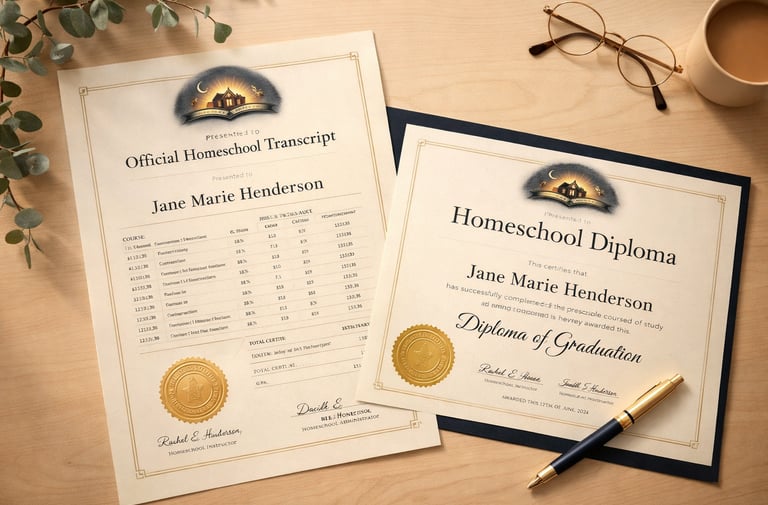
Your day-to-day recordkeeping is your job as the homeschool educator. But when it comes time to turn those records into official graduation documents — a professional transcript, an official diploma, course descriptions, and a cumulative academic record — Homeschool Glow Design House is here to handle it for you.
You bring us the records you have been keeping. We turn them into polished, professionally designed, print-ready documents that represent your child's education with excellence. No design experience required. No software to learn. Just beautiful official documents delivered to your inbox.
Ready to get your documents done right? Visit our Order Now page and choose the package that fits your family.
The families who breeze through graduation documentation are almost always the ones who kept consistent records from the beginning. It does not take hours every week — just a consistent simple system that you maintain throughout the year. Start today regardless of what grade your child is in. Your future self at graduation time will be incredibly grateful.
Set up your system. Keep it simple. Stay consistent. And when the time comes to turn those records into official documents Homeschool Glow Design House will be right here ready to help.
Contact Us
Homeschool Glow provides general educational guidance and organizational tools. Families are responsible for confirming requirements with their state.
© 2026. All rights reserved.
Important Note
Homeschool Glow Design House —Your Homeschool. Officially Documented. Beautifully Designed.