
Homeschool vs Online School vs Hybrid: What’s Right for Your Family
2/22/2026

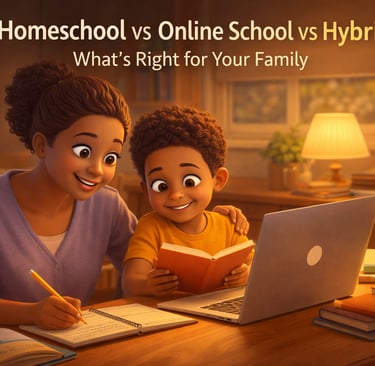
Families exploring alternative education often encounter three common pathways: homeschool, online school, and hybrid learning. While these options share similarities, they differ in structure, flexibility, and parental involvement. Understanding these differences can help families choose an approach aligned with their lifestyle, goals, and child’s learning preferences.
Homeschooling typically represents the highest level of parental autonomy. Parents select curriculum, design schedules, and guide instruction according to their child’s needs. This flexibility allows for personalized pacing, interest-driven exploration, and adaptable routines. Families who value customization, relational learning, and schedule freedom often find homeschooling appealing.
However, homeschooling also requires active planning and facilitation. Parents may need to research resources, track progress, and create learning opportunities. For some families, this responsibility feels empowering; for others, it may feel demanding. Recognizing your comfort level with instructional involvement is an important consideration.
Online school offers a structured alternative within the home environment. Students follow a predetermined curriculum delivered through digital platforms, often with certified teachers providing instruction and evaluation. This model can reduce planning demands for parents while maintaining learning continuity outside traditional school settings.
Online school can be particularly beneficial for families seeking consistency, academic oversight, or alignment with public school standards. Students accustomed to classroom expectations may also transition more smoothly into online learning environments.
Hybrid learning blends elements of homeschooling and structured education. Students may attend in-person classes part-time, participate in enrichment programs, or combine online coursework with home-based activities. This model provides flexibility while preserving opportunities for peer interaction and instructional support.
Hybrid approaches are increasingly popular among families seeking balance. Children can benefit from social engagement, specialized instruction, and collaborative experiences while maintaining schedule flexibility and parental involvement.
When deciding among these pathways, consider your family’s priorities. Flexibility, structure, socialization, academic support, and time availability all influence suitability. Observing your child’s personality and learning preferences can also guide decision-making. Independent learners may thrive online, while hands-on learners may flourish in homeschool or hybrid settings.
Explore homeschool requirements by state
Logistical factors also matter. Work schedules, transportation access, local program availability, and technological resources can shape feasibility. Evaluating these practical elements alongside educational philosophy ensures realistic planning.
Importantly, choosing one pathway does not eliminate the possibility of adjustment. Many families shift approaches over time as needs evolve. Starting with a model that feels manageable today creates momentum and experience that supports future decisions.
Parents often discover that the “right” choice is less about finding a perfect model and more about selecting an approach that supports family harmony and child growth. Education is dynamic, and flexibility allows families to adapt without viewing changes as setbacks.
Exploration can be a helpful first step. Research local programs, observe online platforms, and speak with families using different models. Exposure provides clarity that abstract comparisons cannot offer.
Ultimately, the goal is not to replicate traditional school structures but to create an environment where learning feels accessible, engaging, and sustainable for your family. Whether through homeschool, online school, hybrid learning, or a combination of approaches, meaningful education can take many forms.
Your family’s educational path does not need external validation. It needs alignment with your values, resources, and child’s well-being.
Contact Us
Homeschool Glow provides general educational guidance and organizational tools. Families are responsible for confirming requirements with their state.
© 2026. All rights reserved.
Important Note
Homeschool Glow Design House —Your Homeschool. Officially Documented. Beautifully Designed.